Complete water heater services for Brownsville homes and businesses. From diagnostic troubleshooting and element replacement on existing tank units to full system installation of conventional or tankless water heaters — we restore reliable hot water efficiently.
Water heaters in the Brownsville area work hard year-round. The region's warm incoming water temperatures reduce some strain on heating elements, but mineral content in the local water supply creates sediment buildup that shortens tank life and reduces efficiency.
Water that fluctuates between hot and lukewarm — or runs out much sooner than it should — often indicates a failing heating element, a malfunctioning thermostat, or excessive sediment buildup insulating the bottom of the tank from the burner or lower element. In a tankless system, inconsistent output can point to a flow sensor issue or heat exchanger scaling.
Brownish or rust-tinged water coming exclusively from the hot side of your fixtures typically indicates internal tank corrosion or a deteriorated anode rod. The sacrificial anode rod is designed to corrode in place of the tank itself — once it is consumed, the tank lining becomes vulnerable to rust-through and eventual failure.
Mineral sediment that settles at the bottom of a tank water heater hardens over time. When the burner fires or the lower element activates, water trapped beneath the sediment layer turns to steam and creates popping or rumbling noises. This sediment layer reduces heating efficiency and accelerates wear on the tank floor.
Moisture or standing water around the base of your water heater may indicate a leaking temperature-and-pressure relief valve, a failed drain valve, or — in the worst case — a crack or corrosion point in the tank itself. A leaking tank generally cannot be repaired and requires replacement before the failure worsens and causes water damage to surrounding areas.
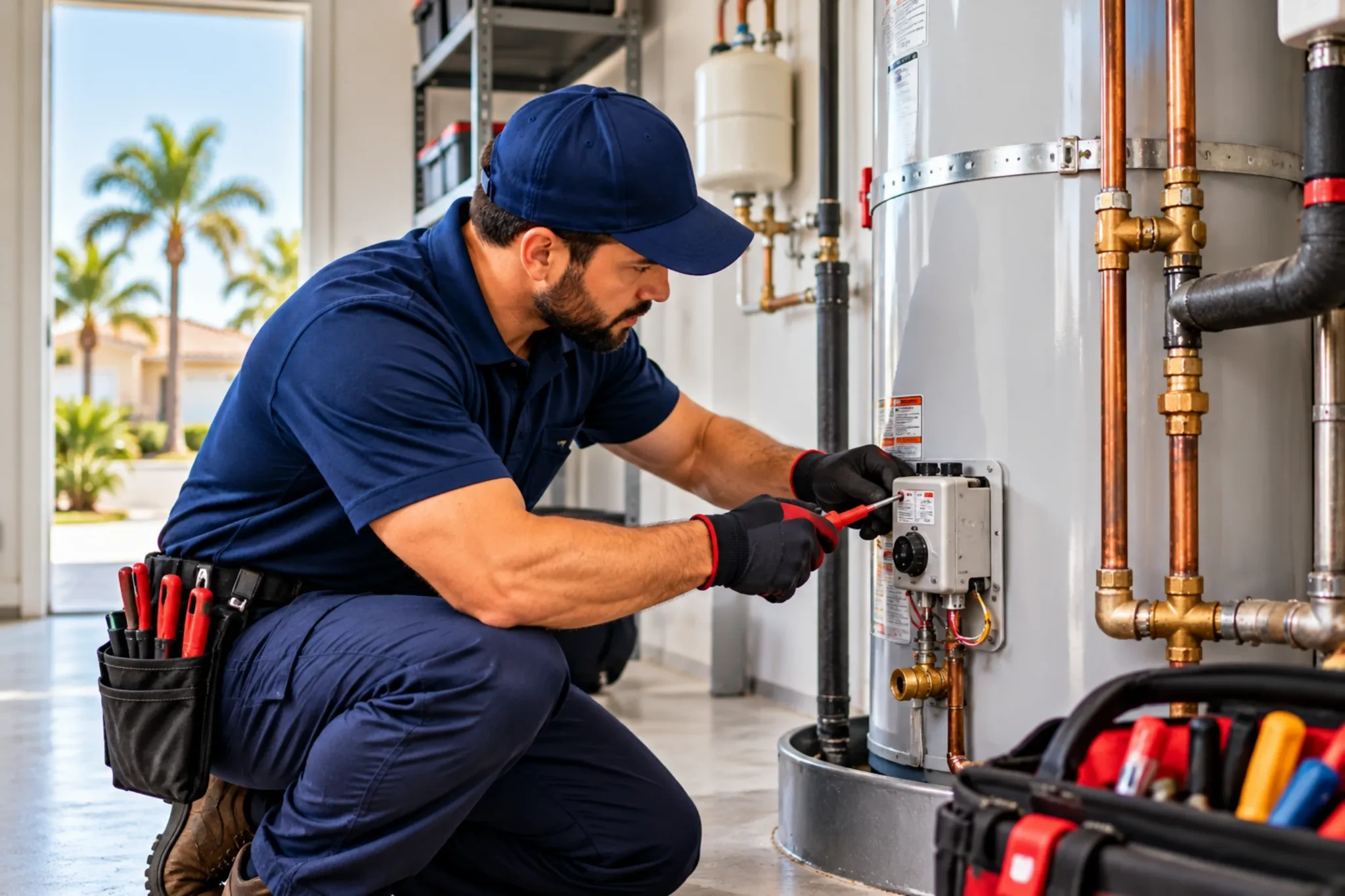
Our Brownsville plumbing team services all major types and brands of residential and commercial water heaters. Whether your property uses a traditional storage tank unit, a tankless on-demand system, or a hybrid heat pump water heater, we have the diagnostic experience and technical knowledge to identify the issue and recommend the right course of action.
For repairs, we carry commonly needed replacement parts including heating elements, thermostats, anode rods, thermocouples, gas valves, and temperature-and-pressure relief valves. When replacement is the better long-term option, we help you evaluate appropriately sized units for your household demand and install them to manufacturer specifications and local code requirements.
We begin with a thorough inspection of the water heater and its connected plumbing. This includes checking the thermostat settings, testing heating elements or burner operation, inspecting the anode rod condition, examining pipe connections for leaks, and evaluating the overall age and condition of the unit to determine whether repair or replacement is the practical choice.
After diagnosis, we explain the issue in plain terms and present your options. If the unit is repairable and the cost makes sense relative to the unit's remaining lifespan, we proceed with the repair. If replacement is recommended, we discuss appropriate unit types and sizes for your household's hot water demand and help you understand the differences between available options.
Repairs are completed with quality replacement parts installed according to manufacturer guidelines. New installations include proper mounting, pipe connections, expansion tank installation when required, gas line or electrical connections as applicable, and verification of safe operation including venting, draft, and temperature output.
Before leaving, we test the repaired or newly installed unit for proper operation, check all connections for leaks, verify temperature output at fixtures, and walk you through any relevant maintenance recommendations — such as periodic sediment flushing or anode rod inspection schedules — to help maximize the unit's service life.
Contact our plumbing team to schedule a water heater diagnostic, repair, or installation appointment. We service all major brands and types of residential and commercial water heaters throughout Brownsville and the Rio Grande Valley.