A running toilet, persistent clog, or leak around the base does more than create an inconvenience — it wastes water and can cause damage to your flooring and subfloor. Our plumbing team diagnoses the specific problem and performs targeted repairs for Brownsville homes and businesses.
Most toilet issues stem from worn internal components, damaged seals, or plumbing connections that have deteriorated over time. Identifying the specific cause is the first step toward an effective repair.
A toilet that runs continuously or cycles on and off without being flushed is typically losing water through the flush valve. The flapper — a rubber seal at the bottom of the tank — may be warped, cracked, or coated with mineral deposits that prevent it from seating properly. In other cases, the fill valve does not shut off at the correct water level, or the overflow tube height needs adjustment. A running toilet can waste hundreds of gallons per day, making prompt diagnosis and component replacement a practical priority.
When a toilet does not flush completely on a single cycle — requiring a second flush or leaving waste behind — the issue may involve insufficient water volume in the tank, a flapper that closes too early, clogged rim jets or siphon jet passages, or a partially obstructed trapway. In Brownsville, mineral deposits from the local water supply can gradually restrict these internal passages, reducing flush performance over time.
Water appearing around the base of a toilet during or after flushing usually indicates a failed wax ring — the seal between the toilet horn and the floor flange. A compromised wax ring allows wastewater to escape with each flush, potentially damaging the subfloor, promoting mold growth, and creating unsanitary conditions. This repair involves removing the toilet, replacing the seal, inspecting the flange condition, and resetting the fixture.
If a plunger only provides temporary relief or bowl water rises dangerously close to the rim after every flush, an obstruction is likely lodged within the internal porcelain trapway or the connecting drain branch. Hardened mineral scale, foreign objects, or improper venting can exacerbate chronic clogging and require mechanical clearing.
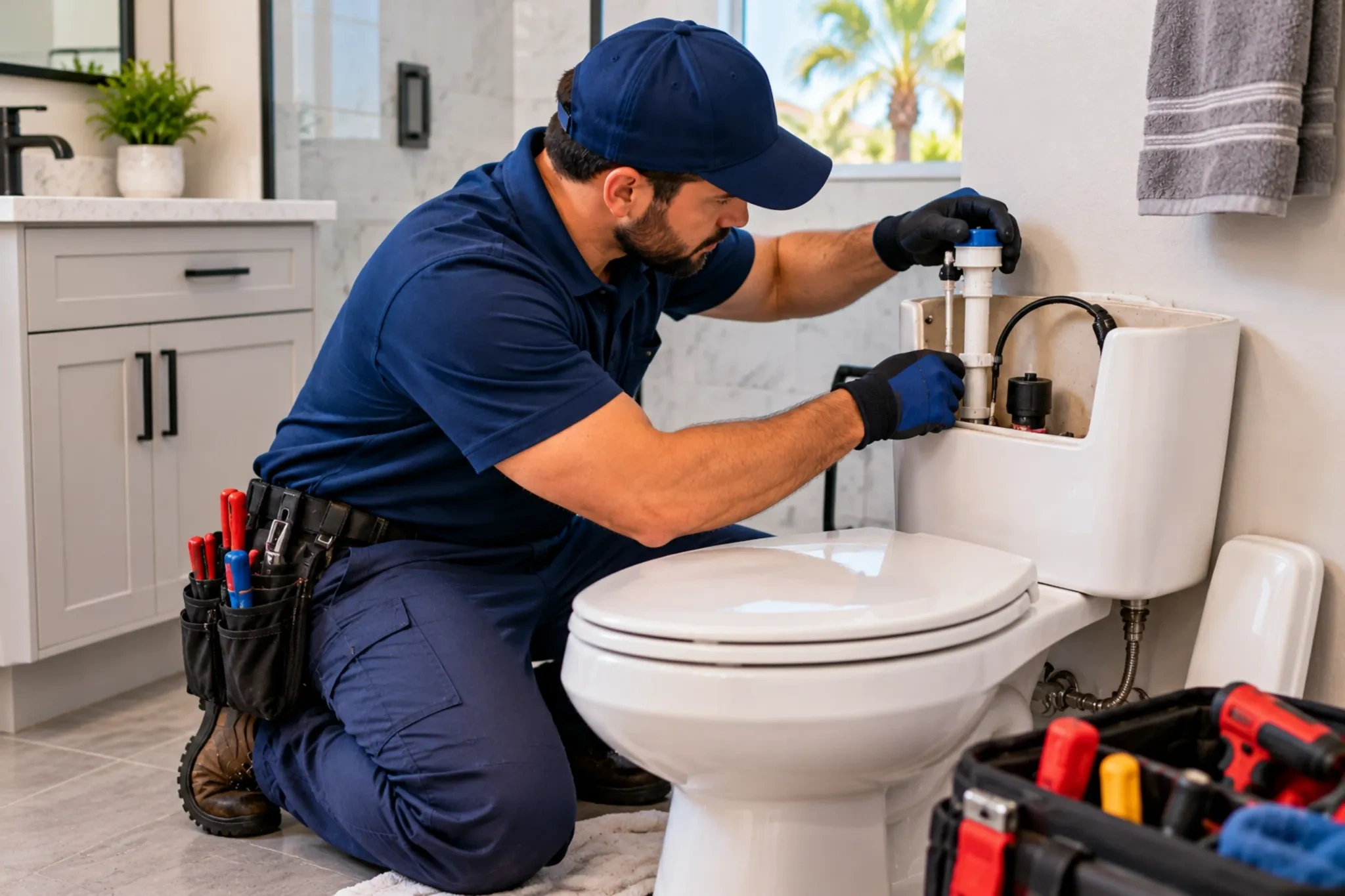
Toilet problems can have multiple contributing causes, and a visible symptom does not always reveal the full picture. A toilet that runs intermittently, for example, may have both a deteriorating flapper and an improperly adjusted fill valve. A base leak may be caused by a failed wax ring, a cracked flange, loose closet bolts, or a hairline crack in the bowl that only leaks under pressure.
Our evaluation examines each component systematically: the fill valve and float mechanism, the flapper and flush valve seat, the handle and lift chain, the tank-to-bowl connection, the wax ring and floor flange, the supply line connection, and the overall condition of the porcelain. We also check for signs of previous repairs that may have used incompatible parts or improper methods.
This component-by-component approach ensures the repair addresses the actual cause rather than masking the symptom. As part of our Brownsville plumbing team's approach, we explain what we find and present repair options before beginning work — so you understand the issue and the recommended solution before any components are replaced.
Flappers, fill valves, flush valves, handles, lift chains, and tank bolts are the most commonly replaced toilet components. Using compatible replacement parts that match the toilet model ensures proper function and prevents recurring issues. We stock common universal components and can source model-specific parts when needed.
Replacing a failed wax ring requires removing the toilet, cleaning the old seal material, inspecting the floor flange for cracks or corrosion, installing a new ring, and resetting the toilet with proper alignment and torque on the closet bolts. If the flange is damaged, it may need to be repaired or replaced before the new seal can function properly.
Persistent or recurring toilet clogs may require professional auger equipment that reaches deeper into the trapway and branch drain than a household plunger can. Repeated clogging at the same toilet may indicate an obstruction lodged in the trapway, a design-related flow restriction, or a developing blockage in the branch line connecting to the main drain.
When a toilet has a cracked bowl or tank, repeated repairs have failed to resolve the problem, or the fixture has reached the end of its serviceable life, replacement may be the more practical option. We help evaluate whether repair or replacement makes more sense based on the age, condition, and performance history of the existing toilet.
Brownsville's water characteristics can affect toilet performance over time. Mineral content in the local water supply contributes to scale buildup inside the tank, on the flush valve seat, and within the rim jets and siphon jet passages. This accumulation gradually reduces flush efficiency and can prevent flappers from sealing completely — two of the most common reasons Brownsville homeowners call for toilet service.
Older Brownsville homes may have toilets that use significantly more water per flush than current models. While these older fixtures may still function mechanically, upgrading to a water-efficient model can reduce household water usage noticeably — a relevant consideration given South Texas water management priorities.
The connection between toilet performance and the broader drain system is also worth noting. A toilet that clogs frequently despite normal use patterns may have an issue beyond the fixture itself — a partially obstructed branch drain, a developing main line blockage, or inadequate venting. If you are experiencing toilet problems alongside other drain issues, our team can evaluate whether a drain cleaning service or a leak inspection is needed alongside the toilet repair.
We start by understanding what you have observed — whether the toilet runs, leaks, clogs, flushes weakly, or exhibits other symptoms. Details about when the problem started, how frequently it occurs, and any previous repair attempts help us focus the inspection.
We inspect each functional component — the fill mechanism, flush mechanism, seals, connections, porcelain condition, and the drain connection beneath the fixture. This systematic check identifies the specific cause rather than assuming the first visible issue is the only issue.
We explain what we found, which components need replacement, and whether repair or replacement is the more practical path. You receive a clear scope of the recommended work before we proceed.
We complete the repair using compatible components, test the toilet through multiple flush cycles, check for leaks at every connection point, and confirm proper fill level and shutoff function. The work area is cleaned up before we leave.
If your toilet is running, leaking, flushing poorly, or clogging repeatedly, contact our Brownsville plumbing team to schedule a professional evaluation and repair.